

Training in South Korea: A Short Guide
Eric goes over some of the basics of training jiu jitsu in South Korea, after having spent a month doing just that.

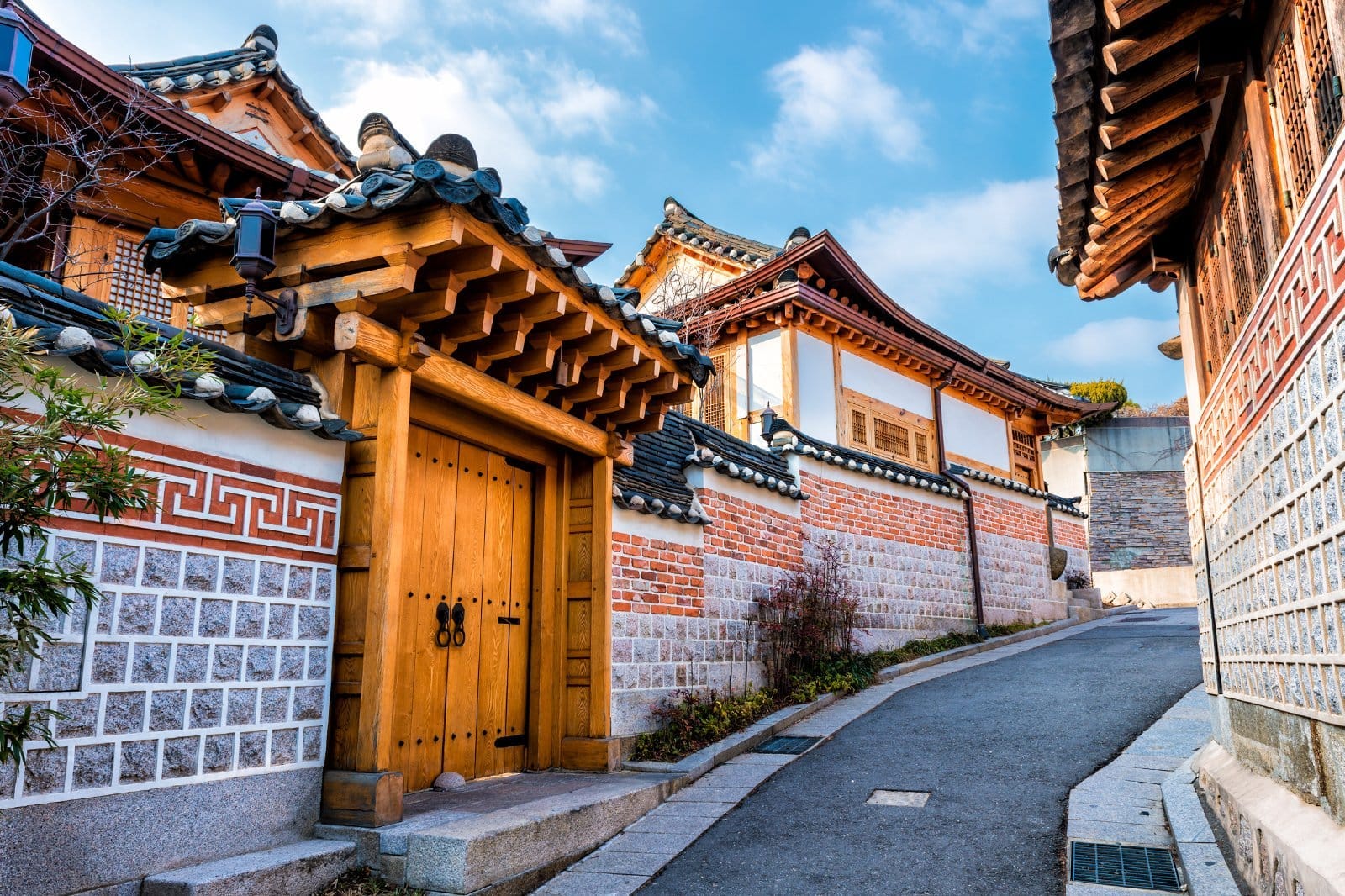
If you’ve noticed, I’ve been a bit quiet the past month or so in terms of output. That’s because I was off traveling in South Korea seeing new sites (and old), training with old (and new) training partners, and just letting my internal battery get a recharge. I really needed it to be honest.
Travel is often seen as a way to escape one’s own routines, a way to reset our emotions, and what I personally see as the most important aspect; simply experience and enjoy what this planet of ours has to offer.
The opportunity to travel as well as train jiu jitsu while abroad has been afforded to me on more than one occasion and so for today’s piece I figured I’d talk about training in South Korea, a place I called home for the better part of a decade.
This won’t be a “go train at this gym” kind of guide as, personally, I don’t think I’ve really been to any gym that really was too difficult to adapt to or participate in. Aside of course from the old “we only really have white belts here, maybe try this gym instead” sort of situations, and that has only ever happened once in about 10 years of training while traveling.
I’ll more so be going over some important info like the basic state of jiu jitsu in Korea, some basic Korean words and phrases to help out with training, and what I think are some notable cultural etiquette differences between Korean gyms versus ones in western countries.
Some Background on Jiu Jitsu in Korea
I don’t think it will come as any surprise that South Korea has a deep-rooted martial arts heritage. Traditionally the Koreans practiced Taekwondo and Hapkido though obviously in terms of “real fighting” those are not as useful. While jiu jitsu originated in Japan then Brazil, its philosophy of continuous learning and humility is pretty closely aligned with the cultural norms within Korean society, which is often pointed out for having a heavy emphasis on harmony and self-improvement.
In recent years, jiu jitsu has gained a ridiculous amount of traction on the peninsula. This growth reflects a broader trend of global martial arts exchange, especially concerning grappling as a sport, but also the fact that Korea is becoming more and more of a meeting point between cultures and societies. I mean look at the absolute success of entertainment coming out of Korea, and you get the gist of what I mean. Korea is becoming quite integrated into the global consciousness both as a participant and a trendsetter.
For expats looking to train and travel, this means that the barrier to entry is quite low compared to where it was just a decade ago. There are, and this is not really hyperbole, gyms in pretty much every other neighborhood in the main urban centers within the country. In terms of the general view of jiu jitsu, the sport has has become widely adopted, even making its way onto major TV networks to discuss, demonstrate, and promote the sport.
As an example, here’s noted Korean MC and megastar Yoo JaeSuk interviewing John Frankl, who is basically THE person who brought in, and set up jiu jitsu training in the country. Which is an entirely different story that I will get to at a later date.
If that’s not enough, then here’s a few random assortments of Korean celebrities trying out the sport on their nationally broadcasted TV shows.
So it’s safe to say that the a good portion of Koreans, in a generalized sense, have seen, embraced, and really become hooked onto jiu jitsu as a sport, a hobby, and as an athletic venue for competition.
As a bonus, and coincidentally happening while I was in the country, the tournament to determine the members of the Korean National Competition Team (the ones who will go on to compete in the Asian Games and be official representatives of the country) was held and and broadcasted on MBC+ in the country. And they’re all available on YouTube in a handy playlist as well as the Women’s finals being in their own video:
So with that primer out of the way, let’s take a look at some useful Korean phrases and words you can learn real quick to help yourself out while training.

Etiquette at Korean Gyms
Note: This is not a catch-all “every Korean and Korean gym does this” section. It’s more so what I’ve personally observed and noted as being defining differences in how Korean gyms operate versus western gyms and things to be mindful of as a visitor.
In general, most cultural differences in how Korean gyms operate versus those in the US/Australia/Europe is not very different. You show up, bow when you get to the mats, don’t be a jerk, and then shake hands and say goodbye as you leave.
However, I think there are some parts of this that are worth highlighting and pointing out as it’s always good to have some information ahead of time to keep in mind.
Basic Etiquette
As mentioned, most gyms in Korea will be understanding and OK with any cultural differences as, after all, you are a non-local so the cultural norms won’t be so strictly applied to you.
However there are some behaviors that are worth abiding to.
First, doing a short and quick bow as you enter the gym (typically towards the head coach) is pretty much how everyone enters. It’s a simple thing and can help show you’re at least trying to follow what other Koreans are doing. I’m not talking doing a deep long bow, just a simple headbob type of bow will be more than enough.
Hygiene
Another thing that’s worth pointing out is that Korea is a place that values good hygiene. This is pretty much the norm across the board and you may already be aware of that. I’m talking taking your jacket off and putting it in a cubby while at a restaurant so it doesn’t get the smell of the food on it, and then also using a Febreeze spray on yourself after the meal. Which makes sense in a “why do I want to smell bad to other people?” kind of way.
When talking about jiu jitsu gyms, it’s equally applied.
First, it shouldn’t be a surprise you will need to take your shoes off before entering the gym. This is normal and typically everyone’s shoes are just left at the front entrance in a sort of chaotic Tetris like organization. There may or may not be slippers you toss on if you need to go use the bathroom (which can be inside the gym or even outside the gym near the stairwell).
One important thing to be mindful of is that, typically, there is a decent emphasis on taking a shower prior to training, as well as after training, though some gyms may not have the facilities for this but that’s rarely been the case. This can be done provided you arrive early enough and a simple rinse and cleaning of any outdoor smells or gunk you may have gotten onto yourself is mostly what this entails. Mostly this is meant to help with any odor or hygiene related stuff you may bring in and is more so done for the benefit of your training partners in addition to your own personal hygiene. If you’re coming straight from an office job, it’s less of a concern but use good judgement of your own body odor to determine if you need to take a quick 2 minute rinse.
Adding to this, clean, odorless gis are pretty much the norm. Meaning, while you may need to hang your gis on a drying rack, using a deodorizing spray is advised (which you can grab at any grocery store or go with nicer smelling odors at places like Olive Young). Also, Korean gyms have in my experienced tended to be a bit stricter about using the same gi for multiple classes in a night. Meaning if you’re going to train let’s say two or three classes, don’t be surprised if you’re asked to change your gi and rashguard as you’ll be pretty sweaty and the like.
Another thing to keep in mind is that in Korea it’s very uncommon and sometimes seen as inappropriate to train without a rashguard on if you’re a guy. At competitions, this isn’t an issue but at a gym for training it’s recommended you wear a rashguard and also do not expose your bare chest outside of the locker room area. Korea is still a somewhat conservative country in this regard, as well as other public displays that may or may not cause issues and so its just best to err on the side of caution and cover up.
Finally in regards to hygiene, the normal etiquette regarding long hair and fingernail grooming applies like in the US/Australia/Europe. Excessive hair products or strong fragrances can be off putting and so making sure your hair is free of that sort of stuff is recommended.
Locker Rooms and Communal Areas
Most gyms in Korea provide locker rooms that have communal showers (sometimes without dividers). So that may be a bit of a shock at first but it’s never been too much of an issue in general.
Additionally, as these are communal areas its highly important to be orderly and not make a mess or leave your belongings strung out. Most gyms have cubbie holes with baskets to toss your stuff in and as is the norm in Korea nobody will really touch your belongings.
Class and Training Etiquette
Normally during training, there is very little talking. Especially when the coach is giving the instruction. This is normal for Korean educational settings as in their context, talking out of turn or when not directly called upon is seen as disrespectful. So don’t be surprised if people don’t talk much during the training as compared to your own home gym.
Furthermore, people may or may not talk much during your individual drilling or rolling but that can also vary depending on the person, their English skills, etc. so that’s a bit hit or miss and hard to give much further details on. It’s one of those “you’ll know when or when not to talk to someone during rolling” kind of things you just figure out on your own.
In this regard, the “laid back” gym culture that comes with a jiu jitsu gym may seem to be missing, but its still there under the surface. You just gotta…go with the flow and you’ll figure out gradually.
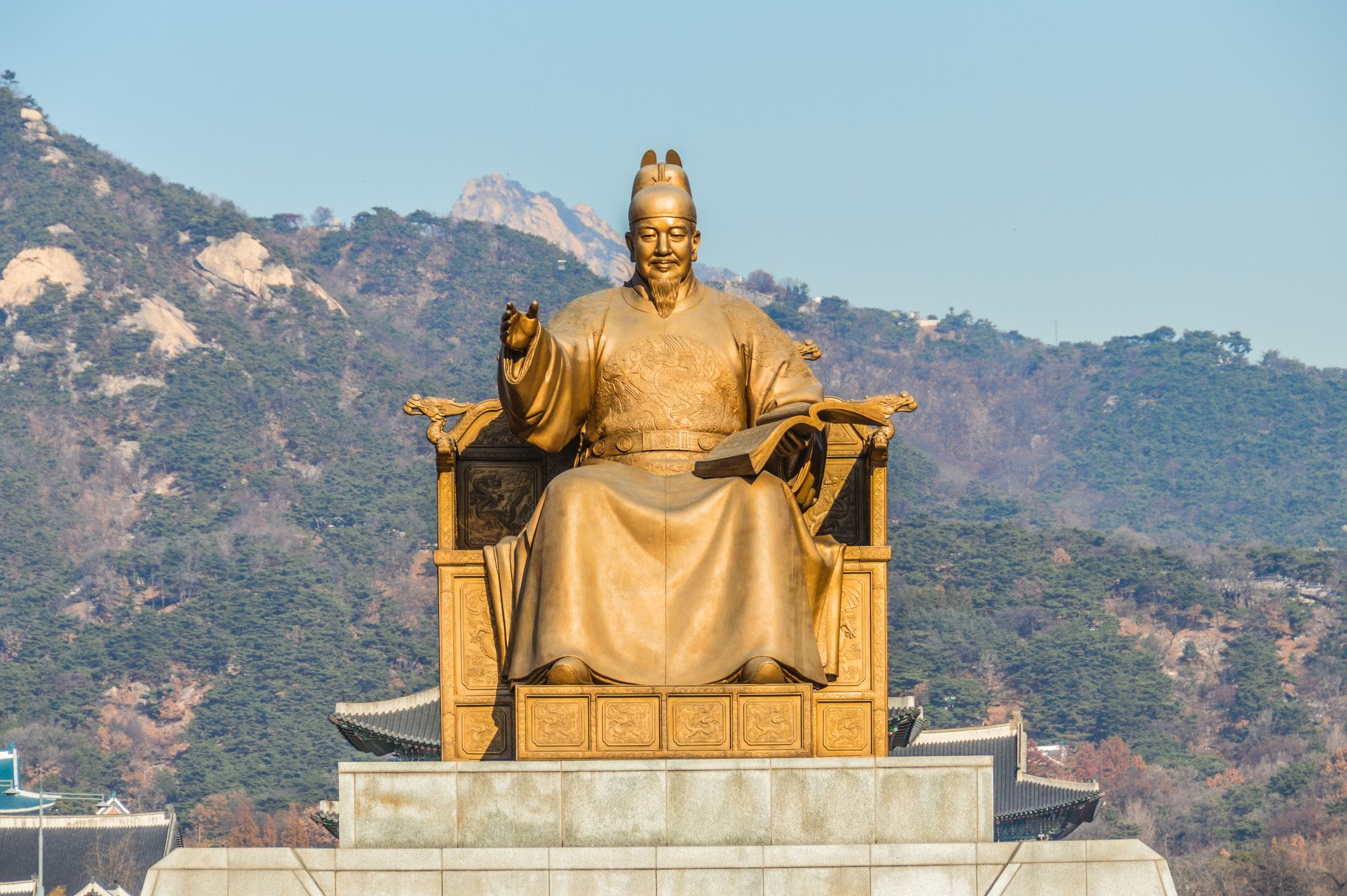
Learn Some Korean
So now that the etiquette stuff is out of the way we can shift to an equally important, and probably far more challenging, topic: speaking Korean.
The first thing to know is that in Korea while English is a mandatory language to learn, not everyone speaks it readily or comprehensively at a high level. There’s many reasons for it but keep in mind that the English availability is more likely to be found in Seoul and Busan than other areas of the country. So while those areas are great to visit, if you end up visiting other regions (which is highly recommended because Seoul & Busan are very much crowded cities), you may struggle to find a gym with someone with a high level of English.
That doesn’t mean it won’t happen. I went to a tournament in a smaller city called Miryang in Gyeonsangnamdo and my opponent spoke better English than anyone else at my gym (which was in a larger city near a university) which was definitely not what I expected.
Anyway, that’s why learning some Korean is useful just to at least communicate basic ideas or thoughts. Training wise, you won’t really need to know much if you just watch what the coach is doing because, well, jiu jitsu is a fundamentally universal concept regardless of language you speak natively.
Another thing to keep in mind is that Korean can be a tricky language to learn at first but there are two key things to remember:
Sentence structure is Subject-Object-Verb (eg. I Apple Eat) rather than Subject-Verb-Object (eg. I Eat The Apple) like in English or other European languages.
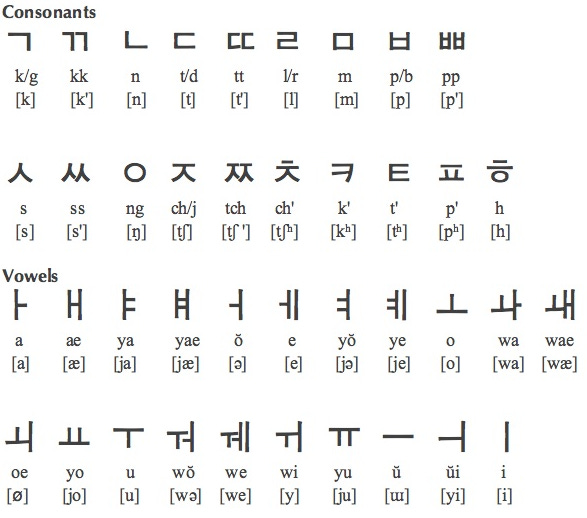
The language and writing is very much phonetic, meaning if you can read the alphabet below (with a useful guide linked here) then you can read out a phrase pretty easily and quickly. Granted you may not understand the response but it can help explain basic phrases like “I don’t speak Korean” pretty easily.
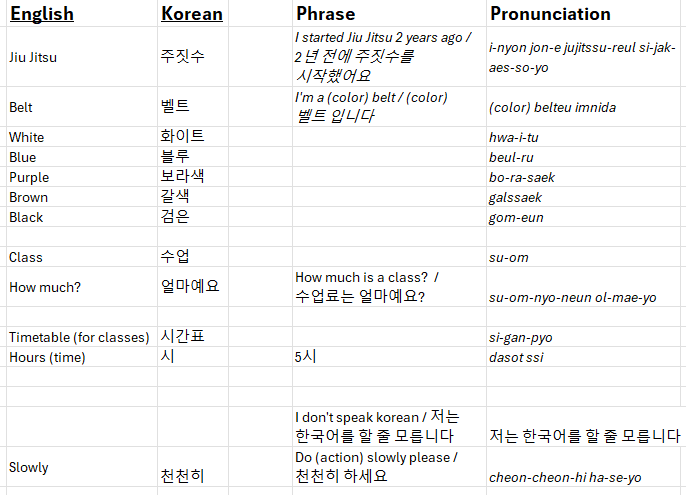
Key Jiu Jitsu Words
Body Parts
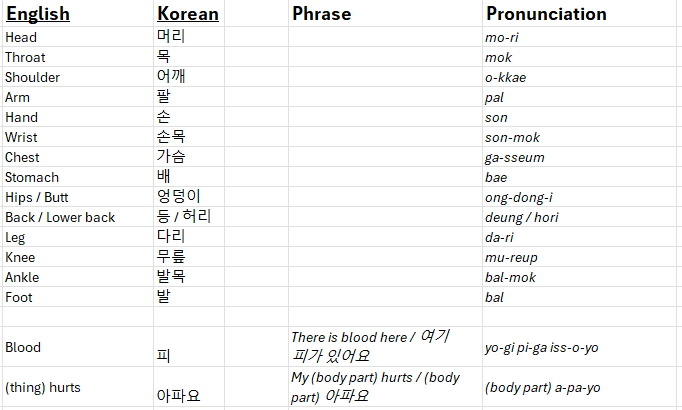
And this should, for the most part, get you sorted. There are plenty of also useful translation apps that can help but while training you should be fine language wise as people tend to be quiet or not speak too much. That said, if they do, just tell them you don’t speak Korean and they will, if they’re confident, try to speak to you in English.
Regarding language translation apps I personally recommend the following:
Papago by Naver: This is much better than Google Translate, owing to the fact more Koreans tend to use Korean company apps than Google thanks to various laws and policies we won’t get into from about 20+ years ago.
Samsung phones also have built in translation tools now which are mostly OK but keep in mind they aren’t so great at the regional dialects of Korean compared to the Seoul dialect (which is what most foreigners learn).
As for the technique names, there’s a big overlap of using English terminology rather than unique Korean terminology (which happens more in judo but that’s also in part due to the resistance to Japanese occupation etc. which is a discussion for another time).
Parting Thoughts
While this isn’t a very in-depth or highly detailed guide, and there are plenty of YouTube channels who specialize in those aspects, it should be enough to get you started with training in Korea.
As a place to train, South Korea is a really welcoming and awesome place to go visit. The people who train jiu jitsu and run gyms are typically very open to having visitors, especially those from overseas, and the opportunities to train there are hard to turn down.